




























In his latest blog about the journey to low CO2 'green' steelmaking in Port Talbot, Peter Jones, Work Package Lead, reflects on the scale of the transformation that has taken place in just 12 months.
“The greatest conversion since St Paul”
In Wales, many people (or a certain age) will associate this phrase with the last-minute touchline goal kick by John Taylor (a flanker!) in Murrayfield that secured a famous 19-18 victory for Wales’s rugby team over Scotland en route to their Grand Slam in 1971.
But it’s a phrase that springs to mind every time I walk round the Port Talbot steel plant and surrounding areas.
Because the place is almost unrecognisable.
And I should know, having spent many years of my life there as a Works Manager.
So, I have recently filmed a video with our Comms team – almost exactly a year on from my first one where I explained what was about to take place.
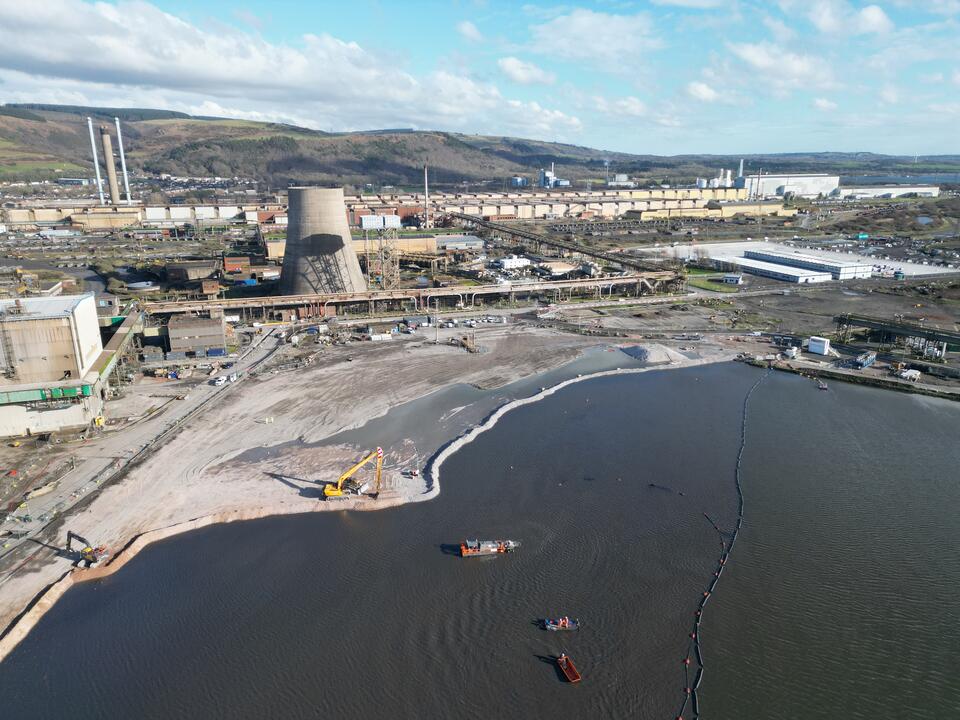
We went round all the major areas of the EAF project, talking about what has changed in 12 months: The scrap receiving yards, the welfare village and offices, the National Grid areas, the BOS lagoon, Harsco Bank, North and South charger bays, and the Teeming bay.
To be honest it would have been a shorter video if I talked through what HASN’T changed!
And I know it’s sad, because thousands of people in the 50 years since the BOS plant was first commissioned, have shed blood, sweat and tears in that place to make sure iron was turned into steel – hour after hour, shift after shift, day after day, year after year. (We reckon that through its life the old BOS plant produced over XXX Million tonnes of steel!)
But the steelplant is not dead.
Far from it.
It may be having the equivalent of major organ replacement, but it will be back better, stronger, and safer than ever before – it will be the steel industry’s equivalent of the bionic man!
And the transformation is the same for large swaths of land surrounding the steelplant:
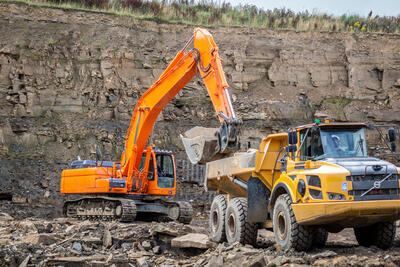
• Harsco bank, the scrap receiving bay and BOS workshops – all gone in preparation for the new consteel scrap conveyor, and now looking like a pin cushion with an array of concrete piles providing the foundations.
• P-Fields (the old slab storage area) now looks like an airport runway ready to receive 70,000 tonnes of scrap a week, with a huge new office and amenities block, too.
• The random pieces of rough land near the gasholder, used as a dumping ground for old bits of kit – now as flat as a vast billiard table, noisy with piling rigs putting in the foundations for the National Grid connection.
• And the BOS lagoon - now partially filled in ready for the new scrap roadway to carry 100t scrap lorries.
The list goes on and on and on…
And I’ve not even mentioned all the work going on at the Casters and the prep work for the new Pickle Line – which in itself is staggering.
The fact that we can now share pictures of the furnace shell and tilting platform, ready to be shipped is just fantastic!
But I tell you all this in the full knowledge that there are many people who are still saying: “They’ll never build it”.
:-O
Well, I hope those people are watching the videos we’re putting out on YouTube, on social media and on our intranet.
I hope those people get to read this blog and the stories and photos on our website.
Because there are lots of things that drive our project team (Tata Steel and contractor partners), every day:
1. To play a part in sustaining steelmaking in the UK for generations to come
2. The excitement of making the single biggest technology change our business has seen in generations
3. Putting in one of the largest EAFs the world has ever seen
4. The chance to give the whole UK manufacturing sector a strong base on which to thrive
5. And, frankly, the desire to prove all those doubters and naysayers wrong
Because we are taking part in a moment in history for people across the Tata Steel UK business and the wider steel industry.
And I genuinely hope that every single employee feels that same sense of ownership that we on the project do of this mind-blowing transformation.
I hope that when workers in every one of our sites and offices—from Hartlepool to Trostre, and Lisburn to Llanwern—talk to friends in the pub, they talk about OUR new Electric Arc Furnace, OUR multi-billion investment, OUR green steel future.
Because it shouldn’t matter that the furnace happens to be in Port Talbot – this investment is to secure the future of our whole Tata Steel UK business.
We just happen to be the lucky ones on the ground putting it all in place.
And to pinch another famous quote: “You ain’t seen nothing yet!”
Watch this space.
Peter
Peter Jones is the Work Package Lead for the design and installation of the new 3.2 million tonnes-a-year Electric Arc Furnace and the Continuous Casters life-extension at Port Talbot Steelworks in South Wales
Peter Jones, Project Lead for the Electric Arc Furnace and Continuous Casters life-extension
See Tata Steel UK's new Electric Arc Furnace! - YouTube
About Tata Steel UK
- The Tata Steel Group has been named one of the most ethical companies in the world, and is among the top producing global steel companies with an annual crude steel capacity of 34 million tonnes.
Tata Steel in the UK has the ambition to produce net-zero steel by 2045 at the latest, and to have reduced 30% of its CO2 emissions by 2030. - In October 2024, Tata Steel ceased ironmaking at its Port Talbot site and temporarily paused steelmaking pending the construction of a 3.2Mtpa Electric Arc Furnace, due to be commissioned late in 2028. For that period, the business will import slab and hot rolled coil to support manufacturing and distribution operations at sites across Wales, England and Northern Ireland as well as Norway, Sweden, France, Germany and UAE. It also benefits from a network of sales offices around the world.
- Tata Steel Group is one of the world's most geographically-diversified steel producers, with operations and a commercial presence across the world.
- The group recorded a consolidated turnover of around US$27.3 billion in the financial year ending March 31, 2026.
Categories